 Flagstaff, AZFor instructors · peakseducation.com/instructors
Teaching the method, never the answer.
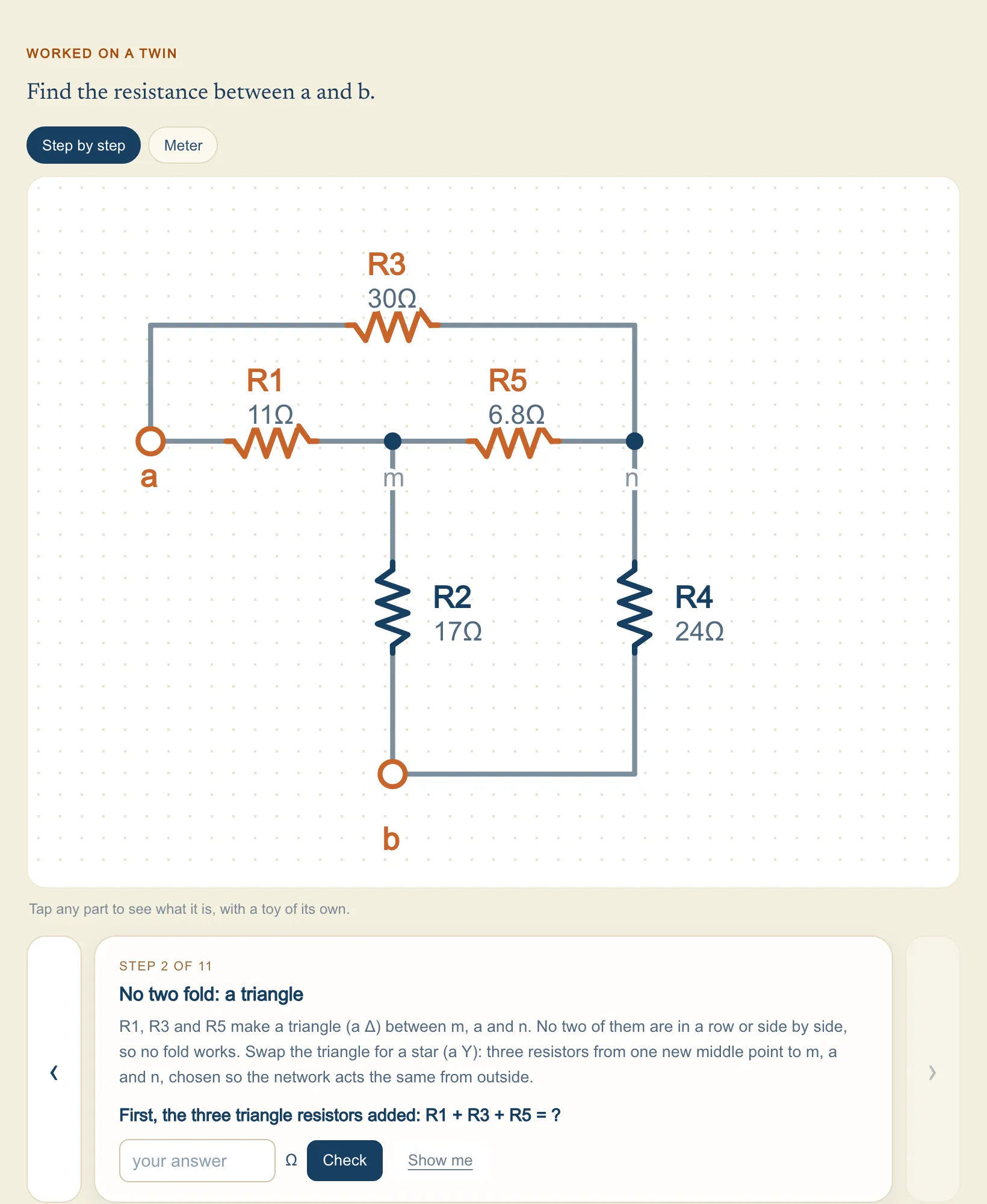
Peaks is a study tool from a small, student-built company in Flagstaff, independent of NAU: not part of the university, and not endorsed by it. A student uploads a homework problem; Peaks teaches its method on a twin problem with different numbers, then checks the student’s own work line by line. It never solves the student’s own problem.
What a student sees
- Upload a homework problem, as a PDF or a photo. Peaks reads it and asks about any number it isn’t sure of.
- Concept: the idea in plain words, with a picture and something to turn.
- Step by step: the method, worked on a twin: the same kind of problem with different numbers.
- DIY: the student’s own problem, line by line, each line checked.
- Sandbox: once it’s solved, change anything and watch every result re-solve.
Academic integrity
- It never solves the student’s own problem. Peaks teaches the method. The student does the work on their own numbers, and Peaks checks it.
- The worked solution is always on different numbers. Step by step runs on a twin: the same setup with numbers of its own. Every worked line uses the twin’s numbers, never the student’s.
- The answers stay locked until the student has solved it. Until then, the answers to the student’s own problem never reach their browser (each check is made on our server), the Sandbox stays locked on their numbers, and any simulation hides the numbers the problem asks for.
- Checks say right or not right, never the answer. A check marks a line or an answer right or not right. It doesn’t show what the right answer is.
Accuracy
- Every number comes from an exact engine. Circuit solvers, a dynamics simulator, steam and gas property tables, a maths engine: engines we write and test. An AI model reads the upload, and a second one double-checks circuit problems; neither makes up a number.
- In doubt, it asks or declines. It never guesses. Where a reading is in doubt, Peaks asks the student about it, or declines the problem and says so straight away.
- 0 wrong answers so far on the founder’s own EE 188 homework. That is one student’s homework, not a study.
What’s covered
- Dynamics (ME 252): particles and rigid bodies: kinematics, Newton's second law, work and energy, impulse, momentum and impacts.
- Circuits (EE 188): DC networks, nodal analysis, Thévenin and Norton, ideal op-amps, and AC phasors and impedance.
- Thermodynamics (ME 291): property tables, closed systems and the first law, flow devices, and cycles.
- Maths (Calculus I–III, linear algebra, ODEs): limits and derivatives through multiple integrals, matrices and eigenvalues, and first- and second-order ODEs.
- Coming soon: statics and mechanics of materials.
For a course
- Free for students during the beta.
- Students sign in with their NAU Google account; Peaks is open to NAU students and teachers for now.
- The file a student uploads is seen only by them and the Peaks team. We never sell student data, and beyond the companies that handle data for us, the only thing that ever leaves Peaks is statistics about groups of students, for research, from which no one can be picked out.
- To try it yourself, sign in with your NAU Google account. Questions first? support@peakseducation.com